Quick Summary
Two bags arrive at the counting point touching each other, and the system records one. That single failure - not a broken sensor, not a bad installation - sits behind most of the count variance that ends up as a short-supply claim or an argument with a transporter at the gate. A sensor cannot fix it, because a beam reports a change of state rather than an object, so the information needed to separate two bags was never captured in the first place.
AI vision changes what gets captured: every bag is identified as a distinct object, tracked across dozens of frames, and counted only once its path clears a validation check. This piece covers the four distinct overlap conditions, how vision resolves each of them, and where the honest limits of any camera-based count sit.
Ask any dispatch supervisor in a cement, fertiliser, or food-grain plant where their count goes wrong, and the answer is rarely "the sensor stopped working." The sensor works fine. The problem is narrower: two bags arrive at the counting point touching each other, and the system records one.
Multiply that by a few hundred bags a shift, and it stops being a technical curiosity. It becomes a short-supply claim, a disputed invoice, an argument with a transporter at the gate, and a monthly variance nobody can explain because there is no record of what actually happened. Overlap is the hardest case in bag counting, and it is the case that separates a sensor from a vision system.
Why Sensors Cannot Separate What They Cannot See
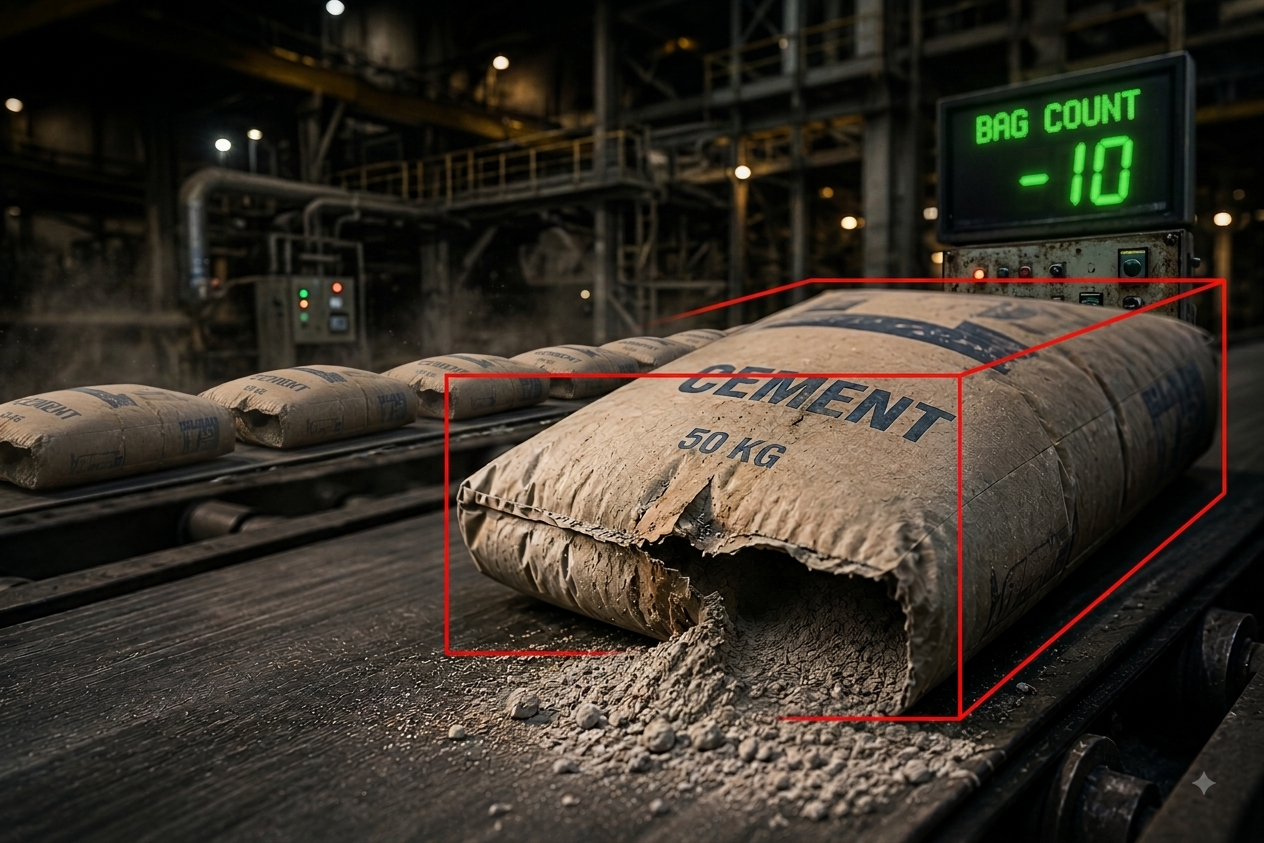
A photoelectric beam, an inductive proximity switch, and an ultrasonic sensor all do the same thing. They watch a single point in space and report a change in state. Beam broken, beam restored. That is the entire vocabulary.
Counting is inferred from it: one break-and-restore cycle equals one bag. Elegant, and correct right up to the moment reality stops cooperating. When two bags travel nose-to-tail with no visible gap, the beam breaks once and restores once. The system has no way to know it saw two objects, because it never saw objects at all; it saw a signal. No shape to analyse, no boundary to find, no second opinion to consult. The information needed to make the right decision was never captured.
Plants engineer around this, and each workaround fails predictably:
- Mechanical separators — bypassed during peak dispatch, exactly when throughput matters most.
- Tighter spacing SOPs — erode by the third hour of a night shift.
- Encoder-pulse logic that infers bag length from belt speed miscounts the moment an underfilled bag arrives shorter than the threshold.
All of them try to force the physical world into a shape the sensor can understand. AI vision inverts that; it changes what gets captured in the first place.
Overlap Is Not One Problem. It is Four.
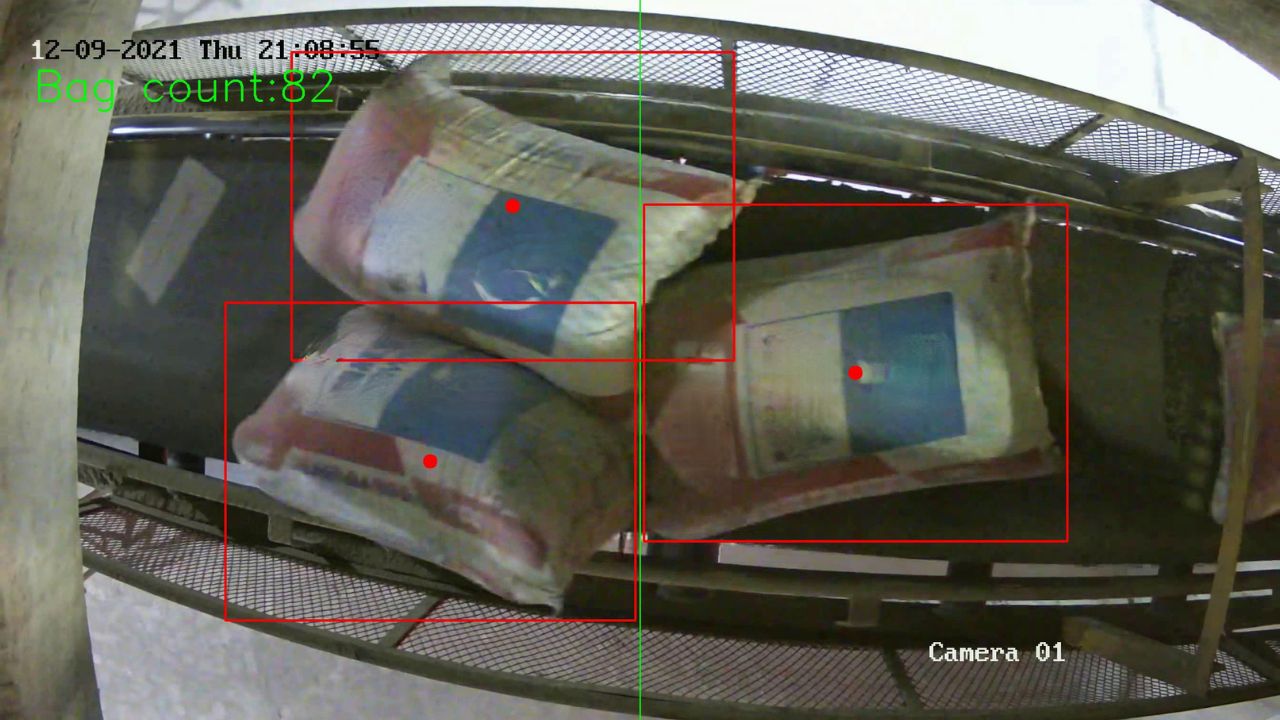
- Lateral contact — two bags side by side, edges touching.
- Longitudinal contact — nose-to-tail with no gap. The classic sensor killer at high throughput.
- Shingling — one bag partly riding on another, genuinely hidden.
- Transient occlusion — a bag briefly blocked by a loader's arm or a chute lip, being loaded but invisible for a few frames.
A system that handles longitudinal contact well can still fail badly on shingling. Any accuracy claim that doesn't say which cases it covers isn't really a claim.
What AI Vision Does Instead
It counts objects, not signals
A vision model performs instance segmentation: for every frame it identifies each bag as a distinct object and draws a boundary around it at pixel level, not a rectangle around a region where a bag probably is, but an outline of that specific bag.
Two bags in lateral contact share an edge, but they do not share a shape. The seam where one ends and the other begins is visible in the image: a change in surface curvature, a shadow line, a break in print or weave direction, a discontinuity in the fold at the bag mouth. A model trained on tens of thousands of real overlap examples learns to find that seam, because in training it was shown the same picture with the answer "two" attached.
Each detected bag then receives an identity, the single step a sensor can never take, and the one everything else follows from.
It Watches Over Time, Not at a Single Instant
A sensor gets one look. A camera at a suitable frame rate gets dozens of looks at the same bag as it crosses the field of view — and this is the quiet advantage that resolves most overlap.
Two bags touching at the counting line were very likely not touching eight frames earlier, and may not be four frames later. Bags shift on a moving belt, settle, rotate, separate for a moment as the belt crosses a roller. The system doesn't have to decide at the worst possible instant. It aggregates evidence across the whole tracked path and resolves ambiguity using the frames where separation was clear.
Re-identification carries that identity across frames, and across cameras where more than one is deployed. A bag that disappears behind a loader's arm for six frames and reappears is recognised as the same bag continuing its journey, not as one lost and one gained.
It Validates the Trajectory Before Committing to a Count
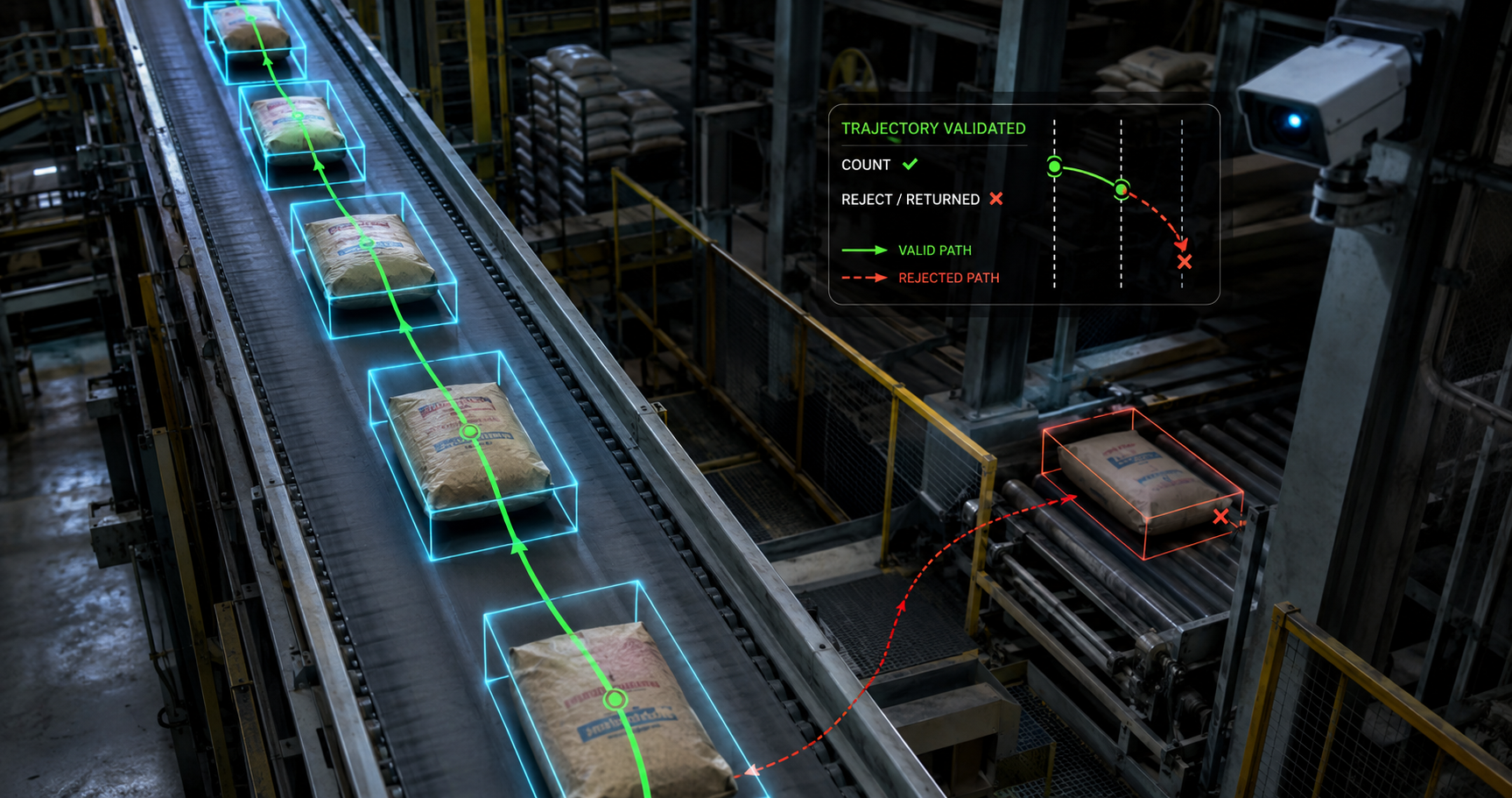
This is where a well-engineered system pulls away from a merely competent one. Detection alone produces jitter — a bag flickers in and out of confident detection near the counting line and gets counted twice, or a bag pulled back off the belt gets counted anyway.
Trajectory validation fixes both. A count registers only when a tracked object's path satisfies a defined condition: entering from the correct side, crossing the virtual counting line in the right direction, continuing consistently with real bag motion. Jitter produces no valid trajectory. A returned bag produces one in the wrong direction. Neither is counted.
It also prevents the opposite error from the one sensors make. A model that aggressively splits ambiguous blobs will over-count, reporting two bags where a single crumpled bag had a deep fold across it. A phantom bag has no consistent path, so it never clears the check.
The Unglamorous Half: Optics and Light
None of this works if the image is bad, and that is where most underperforming deployments actually fail. Three decisions set the ceiling on accuracy before a single line of model code runs:
- Shutter and frame rate, sized against peak flow rather than average. A rolling shutter smears a fast bag where a global shutter freezes it.
- Camera geometry, which decides which overlaps are solvable at all. An oblique angle that sees the seam between two touching bags succeeds where a flat top-down view sees one continuous mass.
- Illumination, which is not optional after dark. Without it, night-shift accuracy drifts by the hour exactly as manual counting does.
These are site-survey decisions, not software settings.
The Honest Limit
Where bags arrive in genuinely continuous contact, a dense unbroken stream with no separation at any point in the tracked path, or a bag fully occluded for its entire transit, no vision system can recover information that was never visible. In those conditions, accuracy has to be assessed against the actual line, not promised in advance, which is why a physical survey and real footage matter more than a specification sheet, and why the count shouldn't stand alone.
Reconciling it against weighbridge net weight gives an independent check on a completely different physical principle. If the count says 1,240 bags and the weight says roughly 1,215 bags' worth of material, the discrepancy surfaces while the truck is still inside the gate, not three weeks later in an email from a distributor.
One note on reading accuracy figures: per-bag accuracy and per-truck reconciliation are different measures. At 1,000 to 1,500 bags per truck, even a 99.97% per-bag figure implies a variance of one to two bags on a given truck. Settle which measure your acceptance decision rests on before deployment.
How Helious AI Bag Counting Handles This
AI Bag Counting is a module of Smart Store, deployable standalone wherever bagged material moves, and feeding Dispatch Planning as the loading-verification layer. It detects and counts every bag the moment it moves, holding accuracy on fast conveyors and high-speed packer discharge. What follows applies whether it is running as an AI bag counting system in a cement plant, on a fertiliser packing line, or at a food-grain wagon loading bay. Every capability below ships in the box.
- Accuracy in the toughest conditions. The model is trained on real industrial footage rather than clean lab data, which is what lets it hold accuracy in the cases that break sensors — overlapping and touching bags, torn and underfilled bags, dust, backlight, and night-shift lighting.
- Trajectory-validated accuracy. A bag is counted only when its tracked path meets a defined condition, and bags are re-identified across frames and cameras. No double counts from jitter, no phantom counts from returned bags.
- Weight reconciliation and dispute protection. The physical count is cross-checked against weighbridge net weight, so discrepancies surface before the vehicle leaves the gate — the independent backstop that closes out short-supply claims.
- Tamper-proof visual evidence and live alerts. Every consignment carries a time-stamped, annotated image record, so any count can be reconstructed and defended. Real-time dashboards and miscount alerts let operators act at the loading point, with every bay on one screen.
- Every loading point, every bag type. Packer discharge, conveyors, truck bays, porter chains and wagon loading, across PP woven, HDPE laminated, AD*STAR, kraft, jute, poly-lined and FIBC jumbo bags.
- Edge deployment and integration. Counts feed straight into your ERP and warehouse systems, running on on-premises edge computers. A loss of connectivity degrades the dashboard, never the counting.
Conclusion
Overlapping bags are not an edge case to be engineered away with better separators and stricter SOPs. At real throughput, they are the normal condition, and any method that depends on bags arriving politely one at a time will keep producing a number nobody trusts.
The shift AI vision makes is not simply cameras instead of sensors. It is a change in what the system knows. A sensor knows something passed. A vision system knows how many objects passed, which was which, where each travelled, and what each looked like. From there, separating two touching bags stops being an impossible inference and becomes an ordinary one.
The test for any plant evaluating this isn't the headline accuracy percentage. Any bag counting accuracy solution worth specifying should answer three questions:
- Which overlap conditions does the system actually handle?
- What operating envelope does that accuracy hold within?
- Is there an independent check for when it doesn't?
A vendor with clear answers to all three is describing an engineering commitment. One with only the percentage is describing a hope.
To see how AI Bag Counting performs against the conditions on your own loading line, talk to the Helious team.